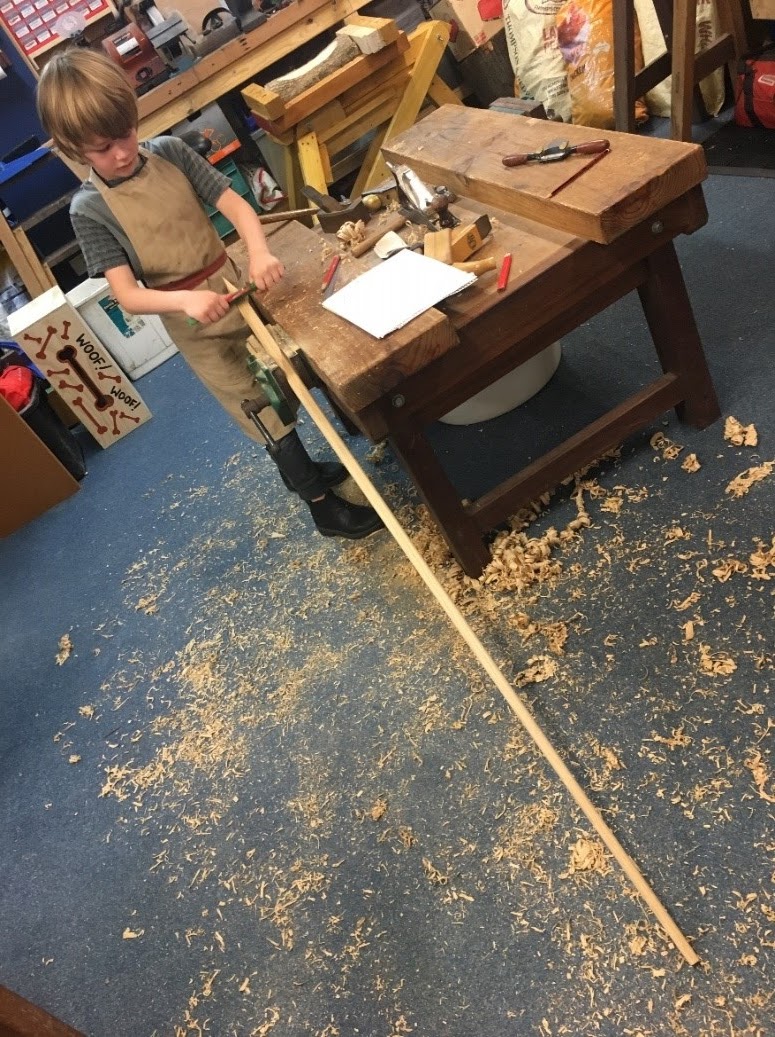
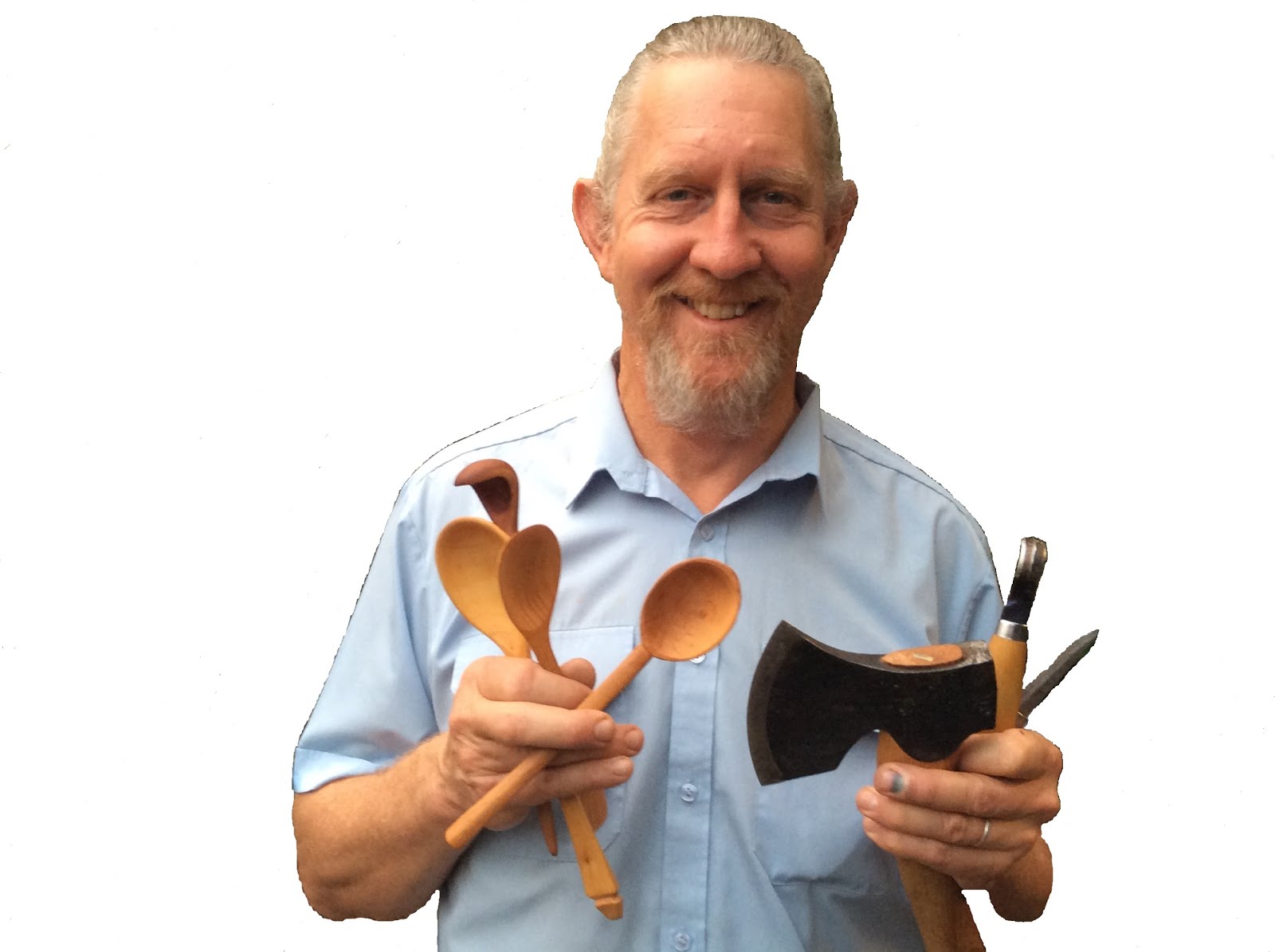
Wednesday, May 22, 2013

Appreciating the wonderful wooden sash moulding plane.

A customer had a couple of old window sashes which were rotten. They wanted to make up the new sashes themselves, but asked me to machine up the material for them from a pile of rough old jarrah they had supplied. This arvo I measured the old component profile dimensions, and machined up the sticks over-long. This included cutting the glazing rebates and the mouldings.
Cutting the profiles with  a sash moulding plane. Stick mounted on a sticking board.

Amongst my growing range of wooden moulding planes, I have a couple of sash moulders. One was a pretty close match to the original, so I used it to run the profiles, after the sticks had been machined to the correct dimensions.

I then cut the rebates over the table saw. Job done. Now it's up to them to cut the wedged mortise and tenon joints and make up the sashes to replace the originals.
Completed sticks, machined, profiled and rebated.
Such a beautiful tool to use, cutting nice clean profiles in the jarrah components.
Wooden moulding planes have been around for centuries. They still have their place, and are a joy to use. No screaming electric router, throwing dust and chips everywhere... just the beautiful sshwiishhhhh sound of the moulding plane cutting the profile. Yes, these old moulding planes are a joy to use.


Sunday, May 12, 2013

Saw sharpening day.

Today was a saw sharpening day. I have a couple of teaching workshops coming up where I will be teaching the pleasures of hand cutting dovetail joints. It was time to get more dovetail saws organised for the bigger groups.
Much of my dovetail saw collection has been amassed (like the rest of my saw collection) over the last few years from antique tool sales, garage sales and flea markets. I am not a Tool Collector, incidentally, for my purpose is to put tools back into service, not into glass cabinets. Many of the priority saws have been piling up in a box awaiting for a sharpening day. That day arrived today.
A few of the saws awaiting cleaning up and sharpening...
Some of the saws needed to be "given a birthday" first: Many needed surface rust removed, some needed a bit of straightening of their saw plate, the odd bit of nut tightening, and a bit of nourishment for the handles. The cleaning up of the saw plate was done with the wire wheel in the bench grinder, wet and dry paper, WD40, steel wool, etc.

When the saws were ready, I donned my magnifying head gear, sharpening equipment, saw vice, and got onto the next phase of the task. Sharpening day was well under way.

What a beautiful array of dovetail saws!! Several of them are well over 100 years old. The brands represented include Sheffield companies like Robert Sorby, Marples, Sanderson Brothers & Newbould, Bowden and then of course Disston from the USA. There are a bunch of other unknown brands present in the pile too, including the inevitable "Warranted Superior"which many companies seemed to use.

The dovetail saws in the pile are a mixture of open handled models, gents saws, and a few closed handled models. I had a few other saws waiting in that pile too, including a couple of old panel saws and small carcass/tenon saws. I'd do them if I had time. Such a beautiful array of saws and all oozing with history.
One of the Gents Saws in the saw vice.
The Gent's Saw. What's in the name? In the 19th century, upper class recreational woodworking gentlemen did not want to appear like the lower class tradesmen, so I understand. Gentlemen required a different style of handle to the tradesmen's saws. Hence the Gent's Saw was born. This style still bears the name to this day.
Sharpening a Gent's Saw using the new Veritas filing guide.
What makes saw a Dovetail Saw? Ideally, they will have a thin saw plate for minimal kerf, minimal set of the teeth, be only 8 to 10 inches long, and be filed with ripping teeth.  Saws are generally filed for ripping (cutting along the grain) or for cross cutting (cutting across the grain). It is the various angles of the teeth which makes the difference. Dovetailing involves cutting along the grain, so the best dovetail saws are filed for ripping - that is, filed straight across. This creates a chiseling action by the teeth - the most efficient and clean way to cut along the grain. Crosscutting teeth are filed on a different angle to create a slicing action on the fibres of the wood. Whatever the style and size of the saws in my pile awaiting sharpening, I was setting them up to be used almost exclusively for dovetailing, so they would all be filed for ripping.  There is a science to getting the shape of the teeth right - but I will save a discourse on that for another post.

In the past I have used a block of wood driven onto the far end of the file as the guide for consistent filing. This was the first time I have used the new Veritas filing guide... and I like it very much.
Looking good. Another saw done. The test cut was good too.
While the filing generally went well, there was one sad story. One of the really old open handled saws had a couple of bad patches of corrosion on the saw plate. There were almost no teeth left on it - I'm sure the previous owner must've been cutting bricks with it! I was having to re-form the teeth on the saw plate. Sadly, while filing a corroded section a small piece blew out. At least the beautiful handle and nuts can be used on another saw.
Bummer. Too much corrosion, so filing caused a blow out. This saw now in the spare parts box.
Keeping the saws sharp.
Some hours later, I had finished filing assorted 10 dovetail saws.
Ten beautiful dovetail saws all cleaned up, freshly sharpened and ready for action
However, the saws would need some protection on their edges to ensure they don't knock against other or against other metal objects, as this bluntens them. I commonly use a piece of 1/2" trickle irrigation tubing slit along much of its length, and held onto the saw with rubber bands made from cross-sections of a bicycle tube. The recycler's solution to protecting the saws' edges.
Protection in place. A pile of ten sharpened dovetail saws.
A good day's work.
It can do your head in, staring hard through your magnifying head gear for hours on end while filing and setting saw teeth. By the time I called it a day, I had filed 14 saws. Ten dovetail saws filed for ripping, three small tenon/carcass saws filed for cross cutting, and a panel saw filed for cross cutting. Sensitive finger tips from too many pin pricks from the sharp teeth, tiredness from concentrating hard for so many hours, and a sore back from so much stooping over the saw vice.

Despite all that, I was very satisfied with the day's achievement. I have never filed so many saws in one day, and I was a few steps closer to getting enough saws ready for the dovetailing workshops coming up in June. It was a good day's work.

At the start of the year, I had resolved that 2013 would be the year that I become very competent at saw sharpening. I reckon things are going according to plan... my skills are improving.
All in a day's work.
Saw sharpening day was a lot of work but very successful. However, I need to do many more such days if I am to make a dent in the huge pile of saws awaiting similar treatment!!  Hopefully my skills will keep improving as I go...  


Sunday, May 5, 2013

Making Small Picture/Photo Frames by Hand.

Amid the usual array of workshops on offer during my last series of public workshops in March, there was a couple of new ones, including: Making a Small Picture/Photo Frame.
We used hand tools only. It was a great process and it's a fantastic little project.

This project will be offered again in the coming public workshop series I'm offering in June.

Nice job, Jenny!
I reckon this will be a popular workshop. Get in early to secure a place!

To tantalize you, here is a bit of a look at the process:

It all starts with the materials.
I regularly obtain some beautiful timber from packing crate material. This comes either from the UK or from USA/Canada. I wish I knew what the timbers were. I just refer to them generally as "Northern Hemispherical Softwoods". Much nicer and closer grained timber than the introduced softwoods grown here in Western Australia: Pinus radiata and Pinus pinaster.

So much potential! That could be a lot of picture frames...
Although I am an enthusiastic hand tool user, I am smart enough to use my machinery to break down the material for all the participants into the required dimensions first! So having pulled apart the packing crates with handsaw, hammer, pincers and pinchbar, the timber was denailed, straightened over the buzzer and machined to width and thickness through the thicknesser. I then docked up a couple of dozen 800mm (32") lengths ready for participants to use for the picture frame project.

Tools for shaping the profiles.
While machinery was used to create the blanks from the packing crates, at 60mm x 22mm x 800mm long, hand planes would be used to create the profiles on them. The four sides would be cut from these prior to the cutting of the mitres.
Hollows, Rounds, and designated moulding planes would be used for the decorative profiles on the face and edges. A rebate plane would be used to create the double rebate to house the glass and plywood back. With an adjustable fence and depth stop, the metal (No78) rebate plane is easier to use than a wooden rebate plane without all this "fruit".
Wooden moulding planes are used to create the profiles.
 
No78 duplex rebate plane is used to create the double rebates.
The Plan.
The pieces of 3mm clear glass for the frames were 250mm x 150mm (10" x6") in size. I had a bunch of these cut at the glazier's. Therefore, this glass will effectively determine our frame size. To make the frames properly, the back will have a double rebate - one to house the glass and one to house the plywood backing which will be screwed into the rear of the frame. Two pieces of timber at 800mm long (32") would give plenty to cut the 4 frames sides from. Using two shorter pieces, rather than one long piece,  would be easier for the planing the profiles. The frame has the double rebate on the back, and a profile on the front side and/or the edges. This profile would be formed with the use of traditional wooden moulding planes. The mitres would be cut and shot by hand, then glued and cramped with a band cramp. While the glue is drying some staples will be put in the back corners of the joints, and the ply back fitted and screwed in place. Flip it over, and start cleaning up the face before the squeeze-out dries. When the glue has dried, off comes the cramp. Final clean up, and coat the frame with whatever finish you're using. When completed, unscrew the back, insert the photo/picture, and fix the back on again. Then all you have to do is decide and apply the hanging method. A great little project.

Cutting the double rebate.
The first task is to create the double rebate on the back of the two pieces of timber.


The drawing above gives a rough idea of how the double rebate works. Apologies to those readers who do not use metric measurements. Set your No78 rebate plane to cut a 7/8" wide rebate, with the depth stop set at 5/32". This will cut the first rebate, which will take the plywood back. When this has been done to both of the sticks, change the setting of the rebate plane to 3/8" wide and 1/8" deep, and cut the next rebate within the first rebate. Hence the double rebate is created. Again, do it to both sticks.  That job done, now it's time to create the profiles on the front side and edges. 

Cutting the decorative profiles on the front face and edges.
The double rebate drawing above shows a couple of example profiles, cut with wooden moulding planes. I have a growing array of wooden moulding planes, including a number of hollows and rounds, beading planes, sash moulders and more. There are endless possibilities.

A couple of examples of easily made profiles. You can see the double rebates.
At this point we won't get into the nitty gritty of using moulding planes - especially untapping the infinite possibilities that hollows and rounds have to offer. We'll save that for another time. It's interesting to note however that for beginners, the simplest method for this project is to use designated moulding planes, like bead moulders and sash moulders. In the pic above, the big sweeping cove (top right) was cut with a No 17 Round (1 3/8"). Left top and right bottom were cut with different radiused bead moulders, and left bottom was cut with a moulding plane commonly used on window sashes. These are designated moulding planes, and each has only one purpose - one profile that it is designed to cut. These are the simplest to use and can still make great profiles for the picture frames. 
Beading plane in use with piece secured on the sticking board.

Preparing the mitres for the frame.
The pieces of glass we have for this project are 250mm x 150mm (10" x 6"), so the frames would be made to fit this piece of glass. With two 800mm (32") sticks on which we have cut our double rebates and profiles, there is plenty of room to cut the 4 pieces. Much of this pine we're using is from packing crates from the USA. Lower grade younger material is used for packing crates - hence there are quite a few small knots amid the material.  The extra material means we've prepared enough to be able to avoid nasty knots, tear-out and other blemishes, as we cut the mitred components. Beaudy.

Check the fit of the mitres in a test drive with the band cramp.
Allowing about 2mm extra overall for the glass to fit, the mitres are marked with mitre square (like on a combination square) and these are cut by hand with a carcass (tenon) saw and a bench hook. 

These are then cleaned up with a block plane using a mitred shooting board. This removes saw marks, inaccuracies, and makes for well fitting clean joints. The four prepared components are put together for a test run with the band cramp. 

If necessary, the joints are tweaked further with the block plane on the shooting board until all four mitred corners are coming together beautifully.  

Gluing up the frame.
My favourite glue for this kind of project is Titebond III. It's strong and dries quickly. Ideal for a gig like this. End grain tends to soak up the glue, so I stick it on all the surfaces, then re-apply on all surfaces again before putting the band cramp around the frame. You can't beat the finger for good glue spreading! A bit of tweaking of each joint alignment before the cramp is tightened, and then the pressure is applied. A cramp like this hold the corners together under pressure beautifully. I do this rebate side (back) facing up. A damp rag is used to clean up squeeze-out. This type of cramp is good because we can get on with cleaning up the joints while the frame is still in the cramp. For this job, there is no additional dowel, spline, or other device to secure or align the joint. The glue does the trick and is enough, because the plywood backing will be screwed into place, adding a significant degree of strength to the whole frame. 

However, I also often apply a couple of staples from a manual upholsterer's staple gun across the joint in each rear corner for additional strengthening, just like picture framers commonly do. Probably not necessary, but I do it because we keep working on the frame while the glue is drying and it is still in the cramp.

Fitting the backing.
Unlike cheap frames which have one rebate which holds both the glass and backing, the double rebate with the backing screwed into it's rebate creates a far superior and more durable frame. If this one falls off the wall the frame will not break. It is tough and made really well, as the fixed plywood backing adds considerable structural integrity. 

The plywood is cut to fit to be housed into the rebate. Small screws, about 1/2" x 6g are used, about 2 per side = 8 screws total. Using a hand drill and countersink, the holes in the plywood re prepared. With the pine frame, there is no need to drill the frame. A spiral ratchet screwdriver can pump the screws in easily. The frame can now be cleaned up with sandpaper if you wish, again while the cramp remains in place. The outside edge of the frame is cleaned up once the cramp is removed. 
Cleaning up the completed frame with a light sanding.
Job done.
The cramp is removed, the light sanding completed, and the frame is ready to receive a finish once the backing is removed.

The glass would then be cleaned and inserted, the photo or picture fitted, and the backing screwed back in place. The hanging method would then be applied and the picture hung. Nice job! 

Such a great little project. Thanks to Ryan for the funky photos in this post.

It's a heap of fun to create such beautiful well made frames by hand - from packing crate material.
The No78 rebate plane and wooden moulding planes are a joy to use, too. 

Come and be part of the fun...

Wednesday, April 24, 2013

Exciting program of Workshops coming up in June!

The coming round of Joy of Wood workshops I am offering in June 20-23 has been finalised.
The venue will be Earthwise in Subiaco, Perth, Western Australia.

As well as the usual favourites like "Carve a Wooden Spoon", "Make Kitchen Spatulas and Salad Servers" there are a few new ones: "Make a Traditional Saw Horse" , "Make a Pencil Box with a  Sliding Lid" and "Unlock the Mystique of the Dovetail Joint". Then there are the workshops for kids on the weekend.

Brief details of the workshops are listed below:

The workshops can be divided into 3 types:

1.   Workshops for people aged 12—112.

 
Make a Traditional Saw Horse

The best companion to every hand saw is a saw horse. Learn to cut the joints and enjoy making this wonderfully functional item. Use it as a small bench, as extra seating at a BBQ, let the kids ride it like a horse, even keep it in the lounge room if you wish — and use it as an indispensable aid to woodworking.

Carve a Wooden Spoon

So much fun, and one of the best ways to get to understand how to work with wood rather than against the grain, as you go from the initial design to the finished product. Learn to use a gouge and mallet, various saws, spokeshave, scraper and rasp. Not only is it a functional item, each spoon is a unique reflection of it’s maker!

Make Kitchen Spatulas and Salad Servers

Stunning and beautifully functional salad servers and cooking spatulas are easy to make and lots of fun too. Get your creative juices flowing as you design and then shape your utensils. Learn to use a range of hand tools as you create these wonderful objects. Make several of them as you get quicker at it...

Make a Pencil Box with a Sliding Lid

Use a range of traditional hand tools to create a lovely lidded box. So simple really, once you know how!. That’s the trick, really.... So be ready to be taken on a journey of discovery as we create these useful little boxes with sliding lids.

Unlock the Mystique of the Dovetail Joint

For thousands of years the dovetail joint has been used to effectively join pieces of wood. In this workshop we will look behind the mystique and discover how simple it really is to make.  So let’s learn to cut some dovetails! They are a joy to make...

Make a Small Picture/Photo Frame

Here’s a great chance to learn to use a number of traditional hand tools, including wooden moulding planes,  to create a beaut little picture/photo frame. A very satisfying project.

2.   Workshops for people aged 6—12.
 

Woodworking for Kids (Make a wooden stool)

Using recycled wood, after a bit of free creative play making stuff we will do a great little project—we will each make beaut little wooden stools, using a range of hand tools.

Woodworking for Kids (Make a useful carry box)

Not just an open box with a carry handle, but also a great way to learn and apply  skills with a range of saws, planes and other hand tools and fixings. Great for storing tools, gardening gear, magazines, and so much more. You’ll reckon it’s too good to use!

3.   Workshop for parents and kids together.  (minimum age 6)

Make a Cajon Drum

Brilliant! We’ll each make one of these drums and then play them together! Cajon drums are an Afro-Peruvian instrument, which you sit on to play. Versatile, awesome, and great fun to play. Learn and use a few basic woodworking skills to create your drum, including hammer and nails, glue, saws, brace & bit. Making your drums is a great experience to share in together.  Take your drums home and get jamming!


Friday, April 12, 2013

The Joy of Carving Wooden Spoons.

I love carving wooden spoons. And I'm not even Welsh.

Over the last few years, Spoon Carving would be one of the most popular of the public workshops that I run. It is a wonderfully tactile process and a lot of fun.

In the Northern Hemisphere, wooden spoons are predominantly made from green wood. We don't have such a menu of suitable timbers here in Australia. So we do some things differently. 

I use mostly hardwoods for wooden spoons. This requires different tools to the green wood spoon makers. Hardwood spoons are incredibly durable as kitchen utensils. As decorative items they are great to carve, take a finish well, and are pretty tough.

A sample of spoons ... such fun to design and make!
The sample of spoons pictured above are as follows, from the top down:
  • The first spoon I made, 1990. WA Blackbutt. Rather mechanical in nature.
  • Sugar spoon, WA Blackbutt. 
  • Kauri Pine spoon, recycled from old fireplace surround. (See below...!)
  • Cooking spoon, Native Cypress.
  • Cooking spoon, Jarrah.
  • Decorative spoon, Sheoak.
Story of a spoon. Life after a fireplace surround...
An old fireplace surround, over 100 years old, came my way. It had 3 of the original 4 split turnings nailed to the face for decoration. The whole thing was made from Kauri Pine, so I pulled it a apart for the timber. What to do with the half spindles?... I cut one in half and carved one into a spoon. Both of those pieces are pictured above - a kind of "before and after" thing.
The 4 old layers of paint are visible on the back of the spoon. This is a decorative, not a functional spoon. It would be a shame to lose the paint from it, as this tells a story. Love this spoon.

Another look at my first spoon - side profile.
It has two design faults: a LH thread and short grain on the cranked shaft.
Well... ya gotta start somewhere!
 
 Spoons are such fun to design and make. There'll be a Spoon making workshop in the next round of public workshops I'm running in June 20-23, to be held at Earthwise in Subiaco.

We will use traditional hand tools only - no noisy power tools. Just traditional tools like a mallet and gouge, coping saw and compass saw, curved scraper, spokeshave, etc. When you make a spoon in this way, it's a bit like you need to establish a relationship with your piece of wood. It is one of the best ways to understand the importance of working with the grain direction and characteristics.

Don't miss it... no previous woodworking experience required.

Saturday, April 6, 2013

Hand Tool Sale 20 April... don't miss it!

After many years of meaning to get around to it, I have finally become a member of the Hand Tool Preservation Society of WA. This wonderful bunch of enthusiastic collectors of old hand tools are an amazing pool of knowledge and expertise.

A number of times a year, members of the Society hold a Tool Sale. The next one is to be held on Saturday 20 April. These sales are not to be missed!   It's Hand Tool heaven.

No cheap and nasty modern mass produced tools here, just the good old stuff.
Tools of quality, oozing with history, and made to last.
The April Tool Sale will be held at the East Victoria Park Anglican Church, Washer Street, East Victoria Park in Perth Western Australia. As I recall it is an 8:00am start, until noon.

If you're interested in hand tools and/or are in the market for some quality hand tools, you'd better get there quick on the day. Watch out, or I might just beat you to the bargains! 

Tuesday, March 26, 2013

Eco-Woodworking article published.

What is Eco-Woodworking?
It's a bit like the woodworking equivalent of the Slow Food Movement. It's about making consicous choices regarding the wood we use, the tools we use, and the way in which we approach the craft. 
In a nutshell, it is working with wood as if the planet matters...

I subscribe to several woodworking magazines from around the world, including the USA, the UK and Australia. One of my favourites would be "British Woodworking", which comes from the same stable as the wonderful "Living Woods" Magazine - both from Freshwood Publishing in the UK.

The December 2012/January 2013 edition of British Woodworking magazine published an article I had written about Eco-Woodworking.

First page of the published article. 


The text version of the article has been re-printed below, with the kind permission of the publisher:
 

Eco-Woodwork Australian Greg Miller explains why approaches and tools are changing

 
The challenge for sustainable living on our precious planet invariably leads us to question and modify all aspects of our lives and lifestyles. We face many choices as we seek to embrace the ideals and concepts bound up in the notion of reducing our footprint on the earth.

As a woodworker, this invariably means I have some key choices to make. For want of a better term, ‘Eco-woodworking’ is a concept I describe as an attempt to do woodwork in ways which are more friendly to the planet. Eco-woodworking consumes less of the world’s resources, reflects a greater commitment to social justice, embodies a greater respect for the trees and forests of the world, and is healthier for my mind and body and for those around me.
 
For centuries, woodworkers have enjoyed using spectacular woods from around the globe. The expansionist centuries of European colonialism saw a wonderful smorgasbord of exotic timber come into common usage by craftsmen in Europe as they sought to satisfy the demands and fashions of their buying public.

In the process, little consideration was given to the destruction of forest ecosystems, the dislocation of indigenous communities, and the devastation of complex biosystems. As one species was depleted and became scarce, another would take its place. So much was wasted, because the world’s forests were treated as infinite. This residual subconscious belief that wood is an infinite resource continues to haunt us today. Huge areas of forest are still clear-felled, and pushed up and burnt, while smaller logs are left on the logged forest floor as residue, because it is seen as ‘uneconomic’ to process them. The ‘recovery rate’ from timber trees, ie. the proportion of the total tree and/or the saw logs which is converted to useable timber, continues to be very low despite advances in sawmilling technology.

All over the world, timber is wasted in huge volumes every day as it is discarded and dumped in landfill. Here it decomposes slowly over decades, generating harmful greenhouse gases. So much of it would have been re-useable, or could have been converted into energy by burning. Wood recycling efforts too often involve chipping wood for landscaping mulches, soil mixes, poultry sheds, and other low grade uses.

One option is to resist the urge to use new timber logged from endangered tropical hardwood forests and temperate old growth forests [unless you are confident the trees have reached maturity and are felled selectively, NG]. If you are going to buy ‘new’ timber, choose re-growth and plantation timbers where you can, from sustainably-managed forests. 

We can re-use timber obtained from salvage, demolished buildings, dismantled furniture, and other sources. Look with fresh eyes at packing crates and pallets, discarded furniture and other sources. Learn to use it and value it as a resource. You’ll be amazed at the beautiful timbers that are available - often for free or for minimal cost because the general populace does not value this material. 

Value the trees 
Trees are essential to the planet as the lungs of the world. As trees convert carbon dioxide to oxygen, one of the by-products is carbon, which is sequestered into the biomass of the tree itself. We need more trees to sequester carbon and reduce the CO2 in the air, and when trees are logged we should be utilising this valuable resource as much as possible and replacing those trees with more.

It has been suggested that as much as 50% of a piece of wood is carbon. Wood is a very low energy material to produce, needing considerably less power than steel, concrete and particularly aluminum to produce. It continues to be a durable, low energy renewable material which has excellent thermal insulation properties amongst other benefits.

No untreated timber should be going into landfill, and if it cannot be recycled it should be burnt in efficient purpose-built fireboxes, kilns and power stations with scrubbers. The growing of trees can take up the carbon emitted into the atmosphere by combustion. Thus the potential is there to create a closed carbon cycle for energy production.

We need trees for energy production and for timber, for shelter/shade, for food, and for habitat for other creatures. However we need to value timber, and plant many more trees than we are planting now.

In my part of the world [Australia] activists wave placards outside furniture retailers who use timber from old growth forests, but few people seem to appreciate the need to call for the responsible re-use of timber from trees logged many decades ago. Much of this timber is contained in the houses and buildings which are being demolished every day and the timber trucked off into landfill.

Tools and machines

Hand tools have been used by to work wood for millennia, and machinery for centuries, and power tools for only a few decades. We need tools to work the timber, to cut, shape, joint and dimension the material. Hand tools have evolved over the centuries in line with technological developments, though it could be argued these developments peaked around the time of the First World War. The post Second World War era saw the decline in quality of hand tools at the same time power tools were beginning to take their place.

Most of the tools available in the big hardware stores today are manufactured in overseas factories where labour is cheap. The materials are predominantly low grade, and the tools are made for a price – the lowest price. However this low price comes at a high price to the environment. Even low grade steel takes an enormous amount of energy to produce.

Buying hardpoints
 
Cheap hardpoint hand saws are not able to be sharpened, as the saw plate is too soft as a low grade steel. In the manufacture of these saws the teeth are cut and then hardened through heat treatment. When blunt, these saws are tossed into the bin, to rust slowly in landfill. All that energy, all those resources which went into the digging up of the ore, the production of the steel, the manufacture of the saws and their distribution around the world – only to end up in landfill along with their nasty plastic handles. Clearly, this is not sustainable for the planet.

Meanwhile it is cheaper to buy another ‘throwaway’ hardpoint saw than to have a good quality traditional saw sharpened professionally.

I remember taking a good saw to my local sawdoctor. "Here," he said as he passed me a hardpoint saw off the shelf, "Save yourself some money." It was $7.00 for a new saw, or $20 to sharpen my great grandfather’s beautiful old Disston saw (which I use every day). I told him I did not want to play that game. My saw has been sharpened many times over the last 100 years and there was no reason my great grandchildren won’t be able to keep using it too – so long as there remains enough sawplate left to sharpen!

In making this choice I am honouring the planet. I am also honouring the saw itself, its previous owners (all wonderful craftsmen) whose sweat is mingled with mine in the wonderful patina of the high quality comfortable wooden handle, and those who toiled over it’s manufacture in Philadelphia sometime between 1897 and 1913.

Choosing the cheap ‘disposable’ saw is choosing to contribute to the unsustainable madness of our resource hungry consumerist lifestyle. Sure it costs me more money to keep making this choice, but at a greatly reduced cost to the planet.

Hand tool quality
 
While the quality of hand tools has continued to decline since the Second World War, the recent renaissance in hand tool woodworking in the western world has in response seen the emergence of boutique hand tool manufacturers who are producing very high quality tools. These are not cheap, but are made to last. They are a good investment if you have the money to buy them.

My preference is to buy good quality old tools from garage sales and flea markets, and to clean them up and bring them back to life. Sure, I am a bargain hunter who likes the thrill of the hunt and the joy of bringing back into use tools which have many stories to tell. It is affordable and does not support the ecologically unsustainable trade in cheap low quality new tools.

There are exponents of this unplugged approach, who have removed many of the machines and power tools from their workshops in favour of hand tools. These include well known US woodworkers and writers Jim Tolpin and Christopher Schwarz, and Nick Gibbs has recently put some of his machines out on loan to a friend.

What is this about? Screaming routers, noisy machines and the essential ear muffs are being put aside to enjoy the full sensual woodworking experience, where you can hear, see, smell and feel the interaction of your tool with the piece of timber you are working. No electricity needed, as you supply the energy. The health and well-being benefits of the physical and mental activity are immense. People working together can talk to each other while they work, so there are social benefits as well.

Techniques
 
Hand in hand with the resurgence of interest in hand tool use is the renewal of interest in traditional skills and techniques, which have proved themselves over the centuries. This is seeing publishers like Lost Art Press and Toolemera Press re-printing old trades books from previous centuries and publishing new books which document and teach the old skills and techniques. Good timing, as too many of these skills and techniques were in danger of being lost.

There is immense pleasure to be found in creating things with our hands. The activity is both good for the body and good for the soul. Eco-woodworking is a holistic approach to enjoying and doing woodwork. It reflects a deep respect for trees, and values wood as a gift from the trees. It appreciates good old tools and respects the traditional skills and techniques. It is thoughtful about the use of the world’s resources, and rejoices in the sense of wholeness and pleasure derived from the physical and sensual activity of hand tool woodworking. The woodworking equivalent of the ‘slow food’ movement.

Details. Greg Miller is a professional woodworker living in Perth, Australia. With his trailer packed full of benches and hand tools, Greg is mobile and can be found sharing the joy of wood in schools, at festivals, in community centres, people's backyards and other locations. He predominantly uses recycled timber which has been rescued. He particularly delights in teaching hand skills and techniques to people of all ages.


So there it is... the article, much edited down from my original draft! 
Thanks to Nick Gibbs the magazine's editor and publisher for giving permission to re-produce the published article.

I enjoy my subscriptions to British Woodworking and Living Woods magazines. It's always a delight when they arrive in the mail. Both a very good read...